

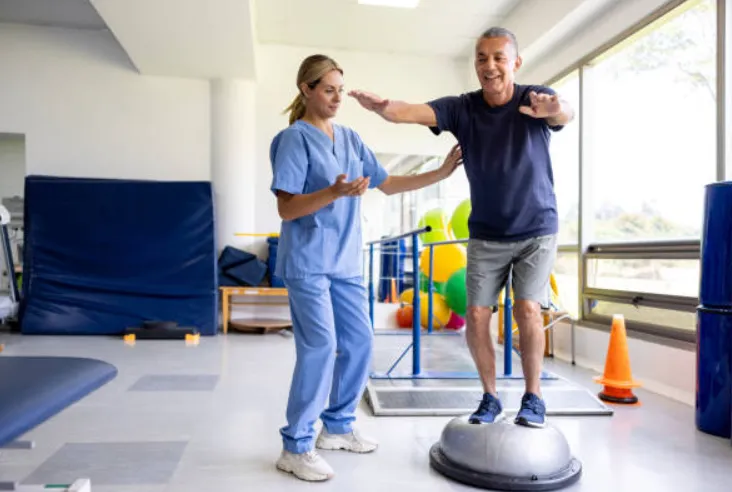
Getting older does not mean getting weaker. It means the body needs smarter support. Falls are the leading cause of injury hospitalisation in Australians aged 65 and over, accounting for around 43% of all injury cases in that age group. Maintaining mobility is the single most powerful thing that protects against that risk. An aged care physiotherapist is the specialist trained to do exactly that, keeping older adults moving safely and living on their own terms for as long as possible.
What Does an Aged Care Physiotherapist Actually Do?
They assess, treat, and build programs. The work covers balance training, strength building, pain management, post-surgical rehabilitation, and mobility aid prescription. It is clinical work grounded in the specific physiology of ageing.
Muscle mass declines at roughly 3 to 8 percent per decade after the age of 30, and the rate accelerates after 60. A physiotherapist works against that decline with targeted exercise and functional movement training tailored to what each person can realistically do.
How Does Physiotherapy Reduce Fall Risk in Older Adults?
Falls do not come from nowhere. They come from weak hip flexors, poor proprioception, slow reaction time, and reduced balance control. A physiotherapist assesses all of these factors and designs intervention programs that address the specific weak points.
The Cochrane Review on fall prevention found that exercise programs, particularly those incorporating balance and strength training, reduce fall rates in community-dwelling older people by around 23%. That is a significant, evidence-based outcome from structured physiotherapy.
What Conditions Does Aged Care Physiotherapy Address?
The list is long. Osteoarthritis, osteoporosis, Parkinson’s disease, post-stroke rehabilitation, chronic back and joint pain, and deconditioning after hospitalisation. Each condition has its own treatment pathway.
For Parkinson’s patients specifically, physiotherapy targeting gait, balance, and freezing episodes has been shown to reduce fall frequency and improve quality of life scores measurably. It is not a cure. It is a management strategy that makes daily life more functional and safe.
How Is a Treatment Plan Developed for an Individual Senior?
It starts with a comprehensive assessment. The physiotherapist evaluates gait, balance, strength, range of motion, pain levels, and daily activity demands. They also look at the living environment because home hazards are part of the risk picture.
Goals are set together with the patient. Independence matters deeply to most older adults. A program designed around meaningful daily activities, like being able to get up from a chair without help, or walk to the letterbox, gets far better engagement than a generic exercise regimen.
What Does a Typical Physiotherapy Session Look Like?
It depends entirely on the person and the goal. A session might include hands-on manual therapy for stiff joints, guided exercises for core and lower limb strength, gait retraining, balance challenges using boards or uneven surfaces, and functional movement practice.
Sessions are progressive. As a patient gets stronger, the challenge increases. Physiotherapy is not passive. The patient does the work. The physiotherapist designs the work and makes sure it is safe, effective, and moving in the right direction.
How Does Physiotherapy Support Independence at Home?
Home visit physiotherapy is one of the most practical tools available in aged care. A physiotherapist visiting at home sees the exact environment a person navigates every day. They can identify trip hazards, recommend grab rail placement, and practice safe movement on the actual surfaces the person uses.
The Australian Institute of Health and Welfare reports that falls at home account for 75% of all fall-related hospitalisations in older Australians. This is where the intervention needs to happen, inside the actual risk environment.
When Should a Family Consider Physiotherapy for an Older Relative?
The moment mobility starts to change. A slight change in walking speed, a reluctance to go up stairs, or a recent near-fall are all early signals. Early intervention preserves more function than late intervention trying to recover it.
Waiting until after a serious fall is too late in many cases. Recovery from hip fractures in people over 80 carries a one-year mortality rate of around 30%. Prevention is not just a quality of life issue. It is a survival issue.